
The scyuncheng JL-04 CNG pressure reducer and JL-03 LPG pressure reducer are used to commission carbureted motorcycles that run on compressed natural gas (CNG) or liquefied petroleum gas (LPG). After installation, work follows a fixed order: leak test, first filling, then idle and power tuning. Factory-installed systems for the same engine model are already bench-tuned before shipment, so more than 90% of those units can be used without further adjustment. In-use motorcycles that receive a new gas system must be tuned on the vehicle, because the exact model cannot always be confirmed in advance.
What Are the JL-04 CNG and JL-03 LPG Motorcycle Reducers?
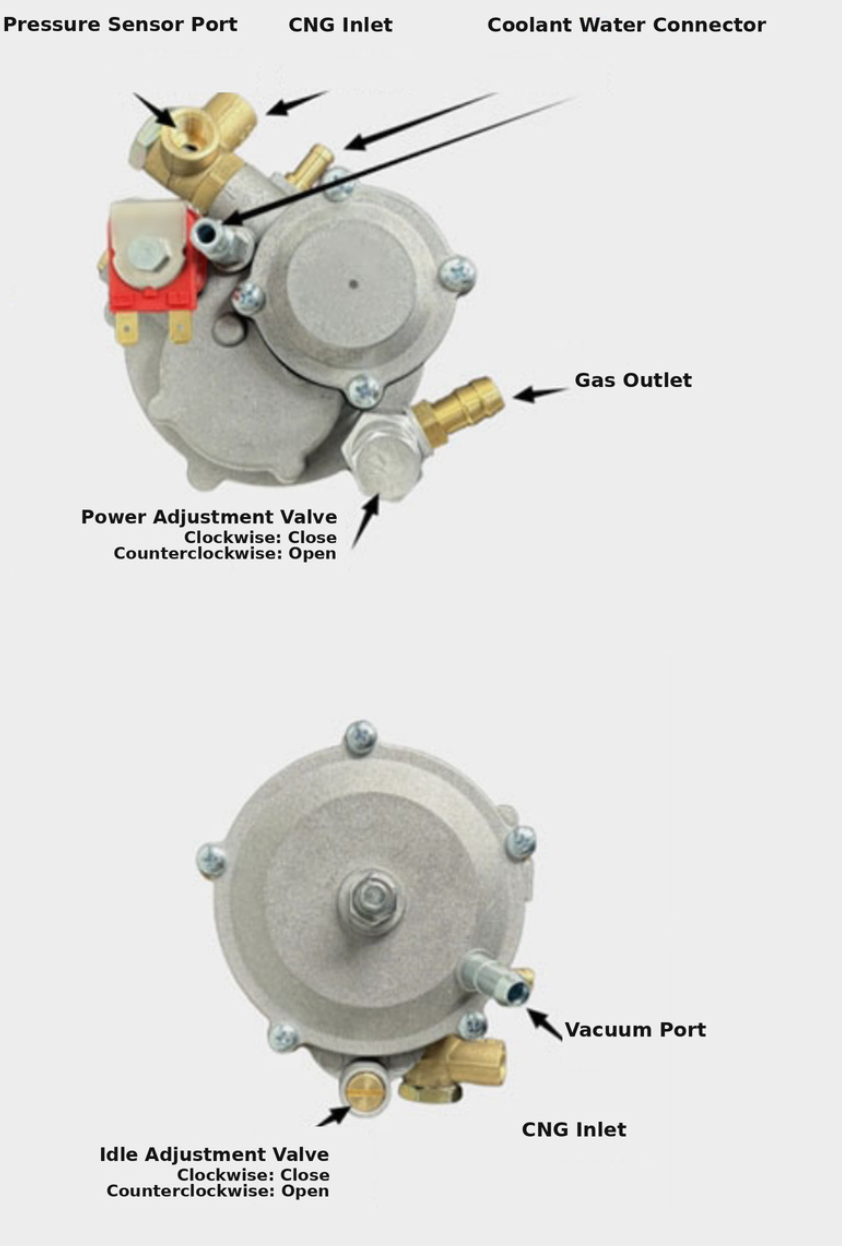
The two reducers share the same commissioning logic, but they are fuel-specific. The JL-04 is the CNG motorcycle pressure reducer. The JL-03 is the LPG motorcycle pressure reducer. Each unit has an idle adjustment valve and a power adjustment valve. The motorcycle also uses a three-position changeover switch: petrol, neutral (petrol and gas both cut off), and gas. Together with the carburetor idle needle, these controls stabilize idle and restore clean acceleration.
On a mono-fuel gas motorcycle, or on a carbureted motorcycle with no petrol left in the carburetor, the engine can be started on gas with the throttle about half open. The first start usually takes several attempts, because the lines and the reducer are still full of air. Once the engine runs, hold a medium speed and warm it up before any adjustment. Do not tune the valves while air remains in the lines or while the engine is still cold.
These reducers belong to the motorcycle CNG/LPG conversion kits range. For a wider overview, see the motorcycle CNG and LPG conversion guide.
Commissioning Specifications
The figures below come only from the scyuncheng motorcycle commissioning procedure. Fields that the source copy does not state are omitted.
| Item | Value stated in the commissioning procedure |
|---|---|
| Product models | JL-04 CNG motorcycle pressure reducer; JL-03 LPG motorcycle pressure reducer |
| Intended use | Commissioning of motorcycle CNG/LPG fuel systems after installation |
| Fuel system type | Carbureted motorcycles; mono-fuel gas motorcycles; dual-fuel (petrol and gas) motorcycles |
| LPG leak-test pressure | 1 MPa, checked with leak-detection fluid on all joints from the cylinder outlet to the reducer |
| CNG leak-test pressures | 1 MPa, then 10 MPa, then 20 MPa; every joint is rechecked at each step |
| First cylinder fill | Not more than 1 MPa, then fully vented to purge air; a second fill may be completed at 20 MPa |
| Factory pre-tune result | More than 90% of same-model, bench-tuned products can be used without further adjustment |
| Idle after factory-system fine-tuning | 1,500–1,700 rpm, set with the carburetor idle needle |
| Final gas idle on an in-use motorcycle | 1,600–1,800 rpm |
| Cold-start warm-up speed | 3,000–4,000 rpm after a successful start, until the engine is warm |
| Relative power in daily use | CNG about 80% of petrol; LPG about 90% of petrol; most noticeable at low speed |
| Changeover switch positions | Petrol; neutral (both fuels cut off); gas |
Which Motorcycles and Engines Does This Apply To?
The procedure is written for motorcycles that use a carburetor and a mechanical gas reducer. It does not list engine displacements, cylinder counts, or named vehicle models, so those details are not added here. It covers factory-installed systems already matched to a given engine model, in-use motorcycles with a newly installed CNG or LPG system, mono-fuel gas motorcycles, and dual-fuel carbureted motorcycles that can still start on petrol. An in-use motorcycle must be tuned on site when its exact type is unknown. Matching hardware is listed under the CNG motorcycle reducer and the motorcycle LPG reducer product pages.
What Parts Are Used in the System?
The commissioning document describes these parts for leak testing and motorcycle CNG LPG tuning:
Gas cylinder and cylinder valve
CNG filling valve, or LPG filling port
Gas lines from the cylinder outlet to the reducer
JL-04 CNG reducer or JL-03 LPG reducer, including the idle adjustment valve and the power adjustment valve
Three-position changeover switch (petrol / neutral / gas)
The motorcycle’s carburetor, including its idle needle (or idle screw)
Leak-detection fluid is used during the pressure test. Components not named in the source copy are omitted from this list.
How Should the System Be Leak-Tested and Filled?
Close the cylinder valve first. Apply 1 MPa of compressed gas at the CNG filling valve or the LPG filling port. With leak-detection fluid, inspect every joint from the cylinder outlet to the reducer. For an LPG system, a clean 1 MPa test completes the leak check. For a CNG system, raise the test pressure to 10 MPa and inspect all joints again, then raise it to 20 MPa and inspect all joints a third time. Only after that third clean check is the CNG leak test complete.
After a successful leak test, fill the cylinder. The first fill must not exceed 1 MPa. Then fully vent that charge to purge air from the cylinder. The second fill may be completed at 20 MPa. Tuning starts only after this filling step.
How Do You Commission a Factory-Installed System?
If the system was supplied for a known engine model and already tuned on a bench, first confirm that air has been purged and the engine is warm. Then check idle, slow acceleration, rapid acceleration, and starting. If all four are normal, no further adjustment is required.
If the carburetor still contains petrol, start on the petrol position. Move the changeover switch to neutral so petrol and gas are both cut off. Hold a higher engine speed until the engine begins to shake, then move the switch to gas and keep that higher speed for more than one minute. This confirms that petrol in the carburetor has been used up. Recheck idle, acceleration, and starting. If any check is poor, tune in this order:
Stabilize idle first. Open or close the idle adjustment valve in small steps. If idle improves, keep adjusting in that direction until it is steady. If idle gets worse or the engine stalls, reverse direction until idle is stable.
Set the power valve at a fixed 1/3 throttle. Hold the right-hand throttle at one-third opening. Open or close the power adjustment valve until engine speed reaches its highest point.
Correct a lean condition during slow acceleration. If engine speed drops or the engine stalls during slow acceleration, the idle gas quantity is too lean. Open the idle adjustment valve slightly until the stumble disappears.
Correct a rich condition on throttle close. If closing the throttle from high speed makes idle unstable or the engine stalls, the gas mixture is too rich. Close the idle adjustment valve slightly until the condition improves.
Set the final idle speed. After the steps above, use the carburetor idle needle to hold a stable idle at 1,500–1,700 rpm.
How Do You Tune a Newly Installed System on an In-Use Motorcycle?
An in-use motorcycle cannot always be identified by a known factory calibration, so the gas system is tuned on the vehicle. Start on the petrol position and raise the carburetor idle screw until idle is above 2,500 rpm. Switch to neutral, run at a higher speed until the engine begins to shake, then switch to gas and hold that higher speed for more than one minute to confirm that petrol in the carburetor is gone.
Hold the right-hand throttle at a steady one-third opening and adjust the power valve until engine speed is at its highest. Reduce the throttle opening and adjust the reducer’s idle valve until speed is again at its highest. Repeat this cycle until the engine can idle with the throttle fully released. Keep adjusting the reducer’s idle valve for the highest stable speed, then use the carburetor idle screw to lower idle so that gas-mode idle finishes at 1,600–1,800 rpm. After that, repeat the five factory-system checks above.
If the engine stalls while switching to gas, start with the throttle about half open. Several attempts may be needed if air remains in the lines and reducer. Then hold the starter, open the throttle slightly, and turn the reducer’s idle valve counterclockwise until the engine shows a knocking (detonation) response. If turning counterclockwise produces no knock, hold the starter again with a slightly open throttle and turn the idle valve clockwise until knocking appears. From that point, open or close the idle valve in small steps until idle is stable, then return to the five adjustment steps. For a closer look at idle behavior on a gas reducer, see how to solve CNG pressure regulator idle instability.
What Counts as a Correctly Tuned System, and How Should It Be Used?
A correctly tuned CNG or LPG motorcycle starts easily, responds smoothly to the throttle, and holds a stable idle after the throttle is released from high speed.
CNG and LPG starting performance is poorer than petrol, so a cold start needs a longer cranking time. After the engine fires, hold 3,000–4,000 rpm until it is warm, then ride normally. If several start attempts fail, too much gas can collect in the cylinder and make the next start even harder. Move the changeover switch to neutral and crank several times to clear the cylinder, then move the switch back to gas and start again.
To switch from petrol to gas, use the same neutral-position method described above and keep a higher speed for more than one minute after switching to gas. To switch from gas to petrol, raise engine speed and move the changeover switch quickly to the petrol position. If the engine stalls, return the switch to gas, restart, raise speed, and switch quickly to petrol again. Repeat until the change is complete.
On CNG, power is about 80% of petrol. On LPG, power is about 90% of petrol. The difference is especially noticeable at low speed. Other riding operations stay the same as on petrol. After parking, close the cylinder valve. If the motorcycle runs on gas for long periods, the carburetor may later have trouble using petrol. Within each week, run on petrol for a few minutes so the carburetor remains able to operate on petrol.
Certification
The source commissioning document for the JL-04 CNG reducer and the JL-03 LPG reducer does not list certificate names, numbers, or approval marks. Buyers who need factory or product documents can review the files published on the scyuncheng certification page and confirm what applies in their market before installation or sale.
Frequently Asked Questions
Riders and workshops often discuss three issues after a motorcycle is converted to CNG or LPG: power loss, hard starting, and unstable idle or fuel-switch stalling. The answers below follow the scyuncheng commissioning procedure.
Why does a CNG or LPG motorcycle lose power, especially at low speed?
Some power drop is expected after conversion. In daily use, a CNG motorcycle has about 80% of petrol power, and an LPG motorcycle has about 90%. The gap is most obvious at low speed. A tune is still considered successful when starting is easy, the throttle is smooth, and idle stays stable after the throttle is closed from high speed. If acceleration stumbles, check the idle and power-valve settings: a lean idle can cause a speed drop during slow acceleration, and the power valve should be set at a fixed one-third throttle to the speed peak.
Why is a CNG or LPG motorcycle hard to start when it is cold?
Gas starting is poorer than petrol starting, so a cold engine needs a longer cranking time. After it fires, hold 3,000–4,000 rpm until the engine is warm. On a first start, air in the lines and reducer can also prevent firing, so several attempts may be required until that air is purged. If repeated failed starts flood the cylinder with gas, move the changeover switch to neutral, crank to clear the cylinder, then switch back to gas and start again. Do not begin valve adjustments until the air is gone and the engine is warm.
Why does the engine stall or idle roughly after I close the throttle, or when I switch between petrol and gas?
Unstable idle after the throttle is closed from high speed usually means the gas mixture is too rich; close the idle adjustment valve slightly until idle recovers. A stumble or stall during slow acceleration usually means the idle gas quantity is too lean; open the idle valve slightly. When switching to gas, use the neutral position and keep a higher speed for more than one minute so petrol in the carburetor is used up. When returning to petrol, raise speed and switch quickly; if the engine stalls, go back to gas and repeat. After parking, close the cylinder valve, and run on petrol for a few minutes each week so the carburetor remains able to operate on petrol.