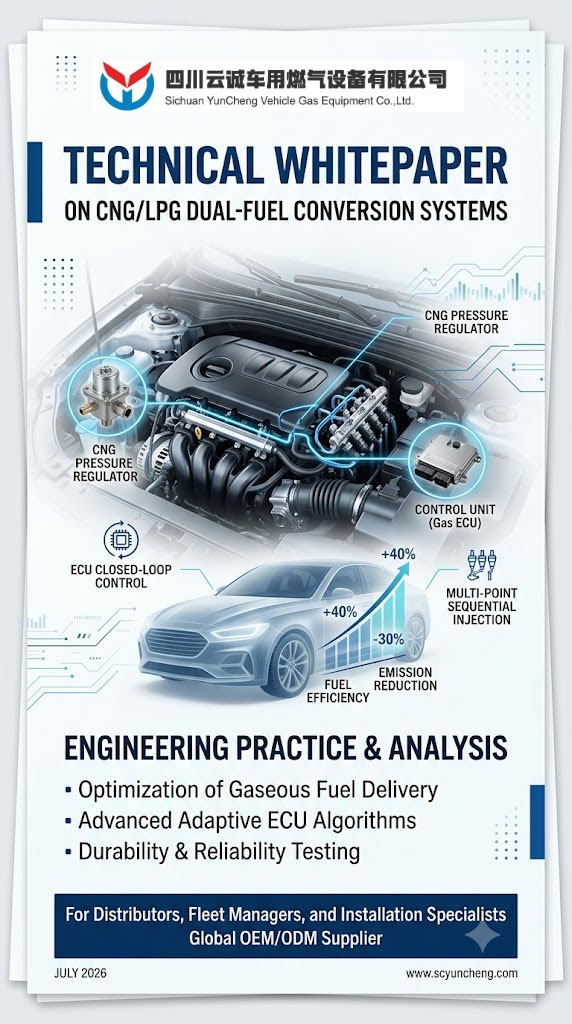
Based on ECU Closed-Loop Control & Multi-Point Sequential Fuel Injection Technology
Table of Contents
Introduction: Autogas Conversion Under Fuel Cost & Emission Pressures
Core Architecture of CNG/LPG Gaseous Fuel Systems
Key Hardware Components & Engineering Selection Analysis
Multi-Point Sequential Injection vs. Traditional Single-Point Systems
System Reliability & Engineering Testing Under Extreme Conditions
Summary & Future Outlook
1. Introduction: Autogas Conversion Under Fuel Cost & Emission Pressures
With fluctuating global oil prices and increasingly stringent carbon emission regulations, converting original gasoline engines into CNG / LPG dual-fuel systems has become the most cost-effective, low-carbon solution for taxis, ride-hailing services, light commercial vehicles, and logistics fleets.
2. Core Architecture of CNG/LPG Gaseous Fuel Systems
The operating principle of modern dual-fuel conversion systems is: "Intercepting the original vehicle ECU injection timing, factoring in real-time gas temperature and pressure corrections, and recalculated by the Gas ECU to drive high-speed gas injector rails."
3. Key Hardware Components & Engineering Selection Analysis
3.1 Pressure Reducer/Regulator: Pressure Step-down & Heat Exchange
CNG high-pressure cylinders store gas at pressures up to 20 MPa (200 bar), whereas intake manifold sequential injection requires a stable working pressure of only 0.12 to 0.20 MPa.
3.2 Smart Gas ECU & Closed-Loop Emulation Algorithms
Tgas = Tpetrol × Kmap × Ftemp(Tgas) × Fpress(Prail) + Tdead
4. Multi-Point Sequential Injection vs. Traditional Single-Point Systems
| Engineering Feature | Traditional Single-Point System | 5th/6th Gen Sequential System |
|---|---|---|
| Injection Location | Throttle Body / Main Intake Duct | Individual Intake Runner Ports |
| Power Output Loss | 15% – 25% Reduction | Minimal Loss (< 5% – 8%) |
| Backfire Risk | High | Eliminated |
5. System Reliability & Engineering Testing
Vehicle retrofit hardware undergoes extreme temperature testing (-40°C to +120°C) and endurance testing up to 10 million pulse cycles.
6. Summary & Future Outlook
As clean fuel infrastructure continues to expand globally, CNG and LPG solutions remain vital bridge technologies for sustainable transport fleets worldwide.
Frequently Asked Questions (FAQ)
What is the difference between CNG and LPG?
Compressed Natural Gas (CNG) is primarily composed of methane and is stored under high pressure, typically around 200–250 bar. Liquefied Petroleum Gas (LPG) mainly consists of propane and butane and is stored as a liquid under much lower pressure. CNG is commonly used for vehicle fuel, while LPG is widely used for cooking, heating, and industrial applications.
Is CNG safer than LPG?
Both CNG and LPG are safe when used with certified equipment and proper maintenance. CNG is lighter than air and disperses upward if leaked, whereas LPG is heavier than air and may accumulate in low-lying areas. Following applicable safety standards and regular inspections is essential for both fuels.
What pressure is CNG stored at?
Most CNG vehicle cylinders are filled to approximately 200 bar (20 MPa), although some systems operate at 250 bar depending on local regulations and equipment specifications.
What equipment is required in a CNG fueling station?
A standard CNG fueling station typically includes a gas compressor, gas dryer, torage cascade, priority panel, pressure regulator, dispenser, safety valves, control system, and associated piping.
How often should CNG equipment be inspected?
Inspection frequency depends on local regulations and manufacturer recommendations. Routine maintenance should include leak detection, pressure testing, filter replacement, valve inspection, and preventive servicing to ensure safe and reliable operation.
Can LPG and CNG equipment be used interchangeably?
No. LPG and CNG operate at different pressures and have different physical properties. Valves, regulators, hoses, cylinders, and other components are specifically designed for each fuel type and should never be interchanged unless approved by the manufacturer.
What are the advantages of CNG?
CNG offers lower emissions, reduced fuel costs in many regions, cleaner combustion, and abundant natural gas resources. These advantages make it a popular alternative fuel for commercial vehicles and public transportation.
How do I choose the right CNG or LPG equipment?
Equipment selection should consider operating pressure, gas flow rate, application,environmental conditions, applicable standards, and system compatibility.Working with an experienced manufacturer helps ensure safety, efficiency, and compliance.